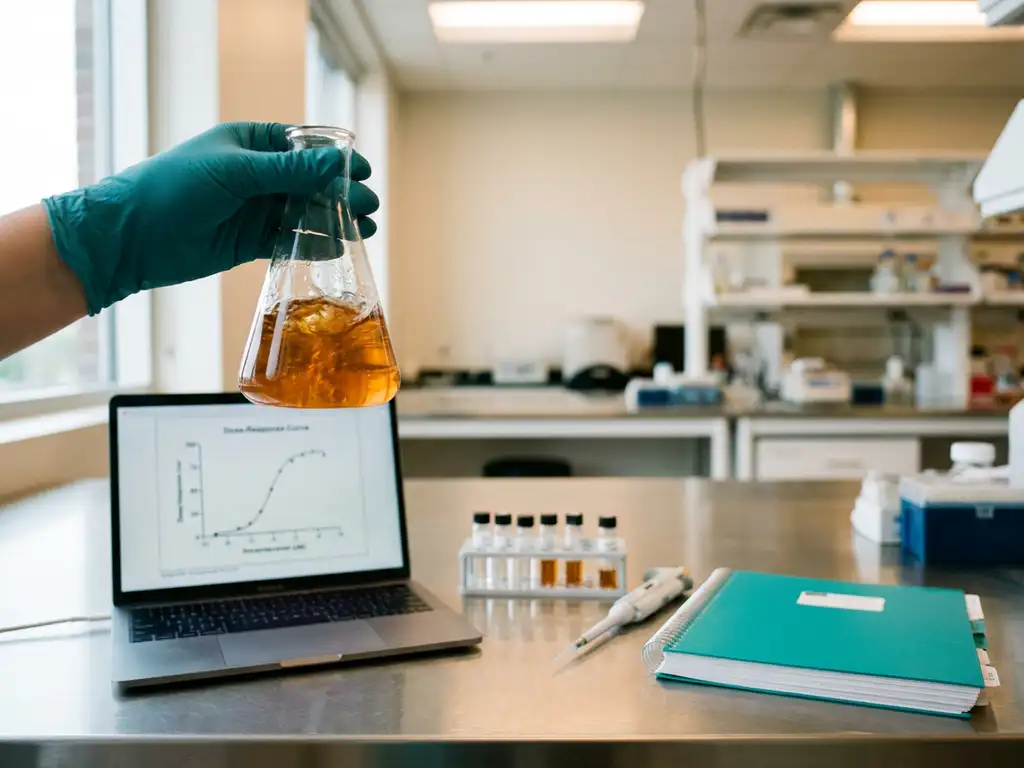
Use preclinical fermentation data to narrow a feeding trial dose range by running a structured dose-response study in an ex vivo gut model, then identifying the lowest dose that produces a consistent, meaningful microbial shift and the highest dose that triggers tolerability signals such as excess gas or unfavourable metabolites. This brackets a practical, trial-ready range.
This approach works best when you test multiple doses across enough individual microbiomes to capture responder variability, and when you predefine what “effective” and “not tolerated” mean for your product category and trial endpoints. The sections below break down study design, endpoints, translation rules, and common pitfalls.
What is preclinical fermentation data and what can it tell you about dose?
Preclinical fermentation data is the set of microbial and metabolic readouts generated when a substrate is fermented by a gut microbiota under controlled conditions, typically in an ex vivo gut model. It can tell you which doses trigger measurable changes, where effects plateau, and where tolerability risks begin, supporting evidence-based dose range selection.
For dose decisions, fermentation readouts are most useful when they show a clear pattern across doses, such as a stepwise increase in beneficial metabolites, a threshold effect, or diminishing returns. Because microbes respond within hours, fermentation data can reveal the initial causal shift that later underpins longer-term host outcomes measured in feeding trials.
In practice, fermentation data helps you answer three dose questions early: which dose is likely too low to move the system, which dose is high enough to deliver a robust signal across individuals, and which dose starts to create unwanted byproducts or excessive gas.
How do you design a dose-response fermentation study to bracket a feeding-trial dose range?
Design a dose-response fermentation study by testing a logically spaced dose ladder across multiple individual donor microbiomes, with appropriate controls, and by predefining decision criteria that map to your feeding trial design. The goal is to identify the lowest dose with consistent effects and the highest dose before tolerability signals rise, creating a bracket for trial dosing.
- Select a dose ladder that spans below expected activity through to a high, stress-testing dose, using 4 to 8 dose levels where possible.
- Use enough microbiomes to capture inter-individual variability, otherwise you risk choosing a dose that only works in a narrow subset.
- Include controls such as a no-substrate control and, where relevant, a matrix control to separate ingredient effects from formulation effects.
- Align exposure and sampling with colonic residence time, typically focusing on 24 to 48 hours for fermentation dynamics.
- Predefine success criteria that match the intended claim or mechanism, not just any statistically significant change.
If your feeding trial design includes multiple arms, fermentation screening can also help you decide whether to run one dose, two doses, or a dose escalation, based on whether the curve looks threshold-like or graded.
Which fermentation endpoints are most useful for narrowing the dose range?
The most useful fermentation endpoints for narrowing a dose range are those that show a monotonic dose relationship and connect to mechanism and tolerability. In most ex vivo gut model workflows, that means combining metabolite outputs, community shifts, and gas production so you can balance efficacy signals against tolerability risk in a single dose-response modelling framework.
- Short-chain fatty acids and related organic acids to indicate functional fermentation output and cross-feeding dynamics.
- Gas production as a practical proxy for tolerability, especially when measured in closed systems.
- Proteolytic or unfavourable metabolites to flag when higher dosing shifts metabolism in an undesirable direction.
- Microbiome composition and diversity to understand which taxa respond and whether effects are broad or niche.
- Inter-individual response patterns to identify responder and non-responder profiles that may affect trial powering and inclusion criteria.
A strong endpoint set supports decisions that are defensible for R&D and regulatory teams because it links dose to mechanism, not just to a single headline metric.
How do you translate fermentation results into a minimum effective dose and a maximum tolerated dose?
Translate fermentation results into a minimum effective dose by finding the lowest dose that produces a consistent, predefined functional shift across individuals, and into a maximum tolerated dose by identifying the highest dose before tolerability proxies such as gas or unfavourable metabolites rise sharply. This turns fermentation curves into actionable thresholds for dose range selection and feeding trial design.
In practice, translation works best when you treat dose as a curve rather than a single comparison. You look for a knee in the curve where effects begin, and a plateau where extra dose adds little benefit. That plateau often defines an efficient upper end for efficacy, even before tolerability becomes limiting.
- Set the minimum effective dose at the first dose that meets your effect criteria in a majority of donors, not just on average.
- Set the maximum tolerated dose at the last dose before a clear inflection in gas or other risk markers, using conservative rules if variability is high.
- Choose trial doses within the bracket, often one near the minimum effective dose and one near the top of the efficient range, depending on your trial objectives.
This is where dose-response modelling adds value: it helps you avoid overinterpreting noise, and it makes your dose choice easier to justify internally when budgets and timelines are tight.
What are common pitfalls when using fermentation data to pick doses for feeding trials?
Common pitfalls include using too few microbiomes, choosing endpoints that do not map to the trial hypothesis, and treating any statistically significant change as “effective”. These mistakes can lead to a feeding trial dose that is underpowered, inefficient, or poorly tolerated, even when the preclinical fermentation data looked promising.
- Undersampling variability by testing only a handful of microbiomes, which hides responder splits and inflates confidence.
- Ignoring matrix and digestion effects when the trial product is consumed in a complex formulation.
- Overdosing based on peak effects even when the curve has already plateaued, increasing cost and tolerability risk without added benefit.
- Cherry-picking endpoints that move in the desired direction while overlooking counter signals such as proteolytic metabolites.
- Assuming longer incubations are required to observe meaningful cross-feeding, which can introduce bias from adaptation rather than capturing the immediate microbial response.
A disciplined analysis plan, agreed before you see the data, is often the difference between fermentation results that inform a confident dose decision and results that create debate.
How does Cryptobiotix help with narrowing down dose range before a feeding trial?
Cryptobiotix helps teams narrow a feeding trial dose range by generating predictive, high-throughput preclinical fermentation data in a validated ex vivo gut model technology, then translating dose-response patterns into clear, decision-ready brackets. We also support programme fit across industry applications and provide access to our scientific evidence to strengthen internal and regulatory confidence.
- Fast dose bracketing with mechanistic readouts in 1 to 2 days of fermentation time, supporting earlier go/no-go decisions.
- Higher confidence dose selection by capturing inter-individual variability across multiple donors for responder insights.
- Tolerability-informed upper bounds using gas production and metabolite risk signals alongside efficacy-linked endpoints.
- Actionable reporting that connects fermentation outputs to practical feeding trial design choices and dose justification.
To discuss your formulation, target cohort, and the right dose ladder for your next study, contact us via our contact page.
Frequently Asked Questions
How many donor microbiomes should I include to make dose decisions reliable?
Aim for enough donors to capture responder variability rather than relying on an average signal. As a practical starting point, include at least 10–20 individual microbiomes for screening, then expand if you see clear responder/non-responder splits or high variance. If budget is tight, prioritise more donors over more timepoints.
How do I choose dose spacing for the ladder if I don’t know the active range yet?
Use logarithmic spacing to cover uncertainty efficiently (e.g., 0.25×, 0.5×, 1×, 2×, 4×, 8× of a reference dose). Set the reference using realistic daily intake constraints (capsule count, serving size) and include one deliberately high “stress-test” dose to reveal tolerability signals.
What controls are most important when testing a formulated product rather than a pure ingredient?
Add a matrix/placebo control that matches the formulation minus the active component, plus a no-substrate control. If the product contains multiple fermentable components, consider testing the active alone and the full formulation to separate ingredient effects from excipient-driven fermentation.
How should I handle donor-to-donor variability when defining ‘effective’ in a dose-response screen?
Define effectiveness using a responder rule (e.g., a predefined functional change achieved in ≥60–70% of donors) rather than only a significant mean difference. Report both the median effect size and the responder rate by dose; this makes it easier to pick a dose that will generalise in a feeding trial.
Can fermentation results inform inclusion/exclusion criteria or stratification for the feeding trial?
Yes. If you see consistent responder patterns linked to baseline features (e.g., low baseline SCFA production, specific taxa, or high proteolytic activity), you can pre-plan stratification or subgroup analyses. Use these signals to refine eligibility, balance arms, or enrich for likely responders—without overfitting to a small dataset.
What’s the best way to turn fermentation endpoints into a single go/no-go dose recommendation?
Create a simple decision scorecard that combines (1) efficacy-linked metabolites, (2) tolerability proxies (gas, unfavourable metabolites), and (3) consistency across donors. Predefine thresholds and weightings, then select the lowest dose that clears efficacy and the highest dose that stays below tolerability thresholds; choose 1–2 trial doses within that bracket.
How do I sanity-check that the selected dose is feasible for a real-world feeding trial?
Pressure-test the bracket against practical constraints: achievable daily serving size, ingredient cost per subject, expected compliance, and regulatory/label limits. If the minimum effective dose is impractically high, revisit formulation (e.g., delivery matrix, co-ingredients) or target population rather than forcing an unrealistic trial dose.